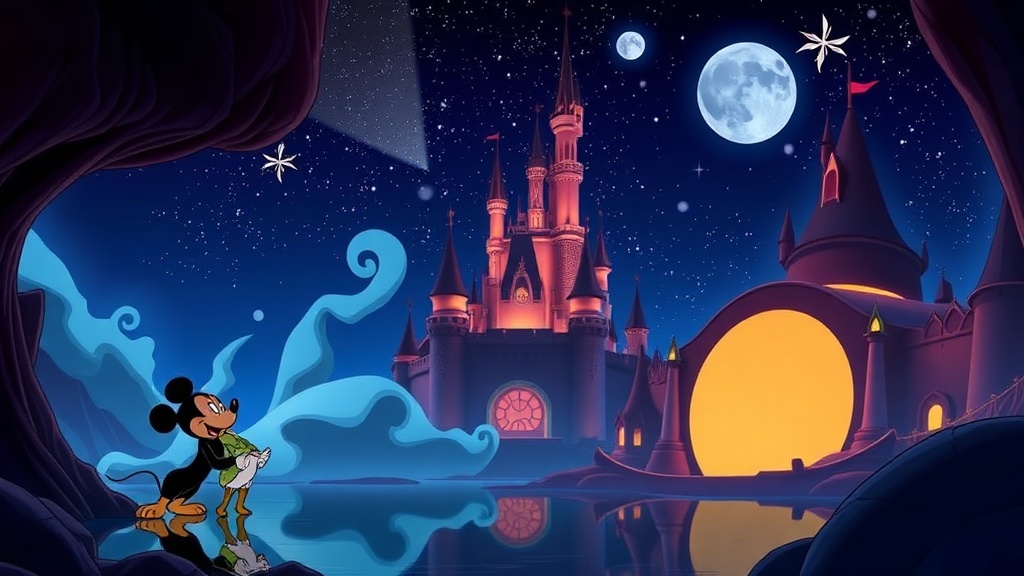
Exploring the Evolution of Disney Animation Styles

Imagine watching the hand-drawn, fluid curves of 1937's Snow White right next to the hyper-realistic, subsurface scattering of light on a character's skin in 2023's Elemental. The difference isn't just technology—it's a complete shift in how stories are told. This post breaks down the technical shifts in Disney animation, from hand-drawn cels to high-end CGI, so you can appreciate the engineering behind your favorite films.
Animation isn't just "drawing moving pictures." It is a complex layering of physics, light, and mathematics. When you watch a modern Disney film, you aren't just seeing a character; you're seeing millions of calculations per second that simulate how light hits hair or how water splashes against a surface.
How did Disney change from hand-drawn to CGI?
Disney transitioned from traditional hand-drawn animation to computer-generated imagery (CGI) by moving from 2D cels to 3D digital models. For decades, the studio relied on artists drawing every single frame by hand. This required thousands of physical sheets of celluloid (cels) stacked on top of one another to create depth.
The shift began in earnest during the 1980s and 90s. While the "Disney Renaissance" era—think The Little Mermaid or Aladdin—was the pinnacle of 2D artistry, the studio was already experimenting with computer-aided tools. They used the CAPS (Computer Animation Production System) developed with Pixar to digitize much of the ink and paint process. This allowed for more complex camera movements that hand-drawn animation struggled to achieve without looking jittery.
The real pivot point was the move toward 3D environments. In the early 2000s, the studio leaned heavily into the digital look that defined the era. This wasn't just a change in medium; it was a change in the very DNA of the art. Instead of drawing a character's expression, animators now manipulate a digital "rig"—a skeletal structure that allows for much more nuanced, subtle movements.
It's a bit like the difference between a painting and a digital puppet. One is a static capture of a moment; the other is a living, breathing digital entity. If you love the way characters interact with their surroundings, you might enjoy seeing how these details are hidden in your favorite films. You can learn ways to spot Hidden Disney Easter Eggs to see how the tech allows for more complex "hidden" details in the background scenery.
The Eras of Disney Animation
To understand where we are, we have to look at where we've been. The evolution isn't a straight line—it's a series of distinct technological leaps.
- The Golden Age (1937–1942): Focused on the perfection of hand-drawn movement and multiplane camera techniques to create depth.
- The Renaissance (1989–1999): A hybrid era where traditional 2D animation met digital ink, paint, and early 3D background elements.
- The Digital Revolution (2000s–Present): The complete move toward 3D CGI, focusing on lighting, texture, and physics-based animation.
What makes 2D and 3D animation different?
The primary difference lies in the way volume and light are handled. In 2D animation, the artist is responsible for "faking" the illusion of 3D space through perspective and shading. In 3D animation, the computer calculates how light bounces off surfaces based on mathematical models of physics.
Think about the way a character's hair moves. In a 2D film like Hercules, the hair is a shape that changes slightly with every frame. In a 3D film like Frozen, the hair is a collection of thousands of individual digital strands that react to wind, gravity, and the character's movement. It's a massive leap in computational power.
Here is a quick breakdown of the technical differences:
| Feature | Traditional 2D Animation | Modern 3D CGI Animation |
|---|---|---|
| Primary Tool | Pencil, Ink, and Paint | Digital Rigging and Texturing |
| Depth | Simulated via "Multiplane" cameras | Calculated via 3D XYZ coordinates |
| Lighting | Painted onto the frame | Simulated via light sources and shaders |
| Character Movement | Frame-by-frame drawing | Manipulation of a digital skeleton |
That said, the "look" of 2D isn't dead. Modern Disney films often use 3D tools to mimic 2D aesthetics. This is a technique called "Cel Shading" or "NPR" (Non-Photorealistic Rendering). It allows the studio to have the depth of 3D while maintaining the charm of a hand-drawn aesthetic. (It’s a way to get the best of both worlds, really.)
How does lighting affect the animation process?
Lighting is the unsung hero of modern animation. In the 2D era, lighting was a matter of color palettes—choosing a slightly darker shade of blue for a shadow. In the 3D era, lighting is a physics problem.
Modern animators use "Global Illumination" models. This means when a character stands near a red wall, the light bouncing off that wall will actually cast a tiny bit of red light onto the character's skin. This is why modern films look so much more "expensive" or "polished" than older ones. The detail is in the light. It's not just about the character; it's about how the character exists within their environment.
This level of detail is why you can't just "use" any computer to make a movie like Moana. The rendering process—the time it takes for the computer to actually "draw" the final image based on all those light and physics rules—is immense. For a single frame of a high-end Disney film, the computer might work for hours. This is a far cry from the relatively quick turnaround of a hand-drawn frame.
If you're a fan of the visual aesthetics of these films, you might also enjoy collecting physical media or even certain collectibles. For instance, if you're looking to expand your collection, you can check out how to start your own Disney Vinyl collection to see how different art styles translate to physical media. The visual depth of a film often translates beautifully to high-quality physical releases.
The evolution of Disney animation is a constant tug-of-war between the desire for realism and the desire for stylized art. We've gone from the soft, watercolor backgrounds of Bambi to the hyper-detailed, almost tactile textures of Encanto. While the tools change, the goal remains the same: making the impossible look believable.
Whether you prefer the nostalgic warmth of hand-drawn lines or the breathtaking scale of digital worlds, the technical progress is what keeps the magic alive. The next time you're watching a movie, look past the characters. Look at the light, the shadows, and the way the textures move. That's where the real engineering happens.