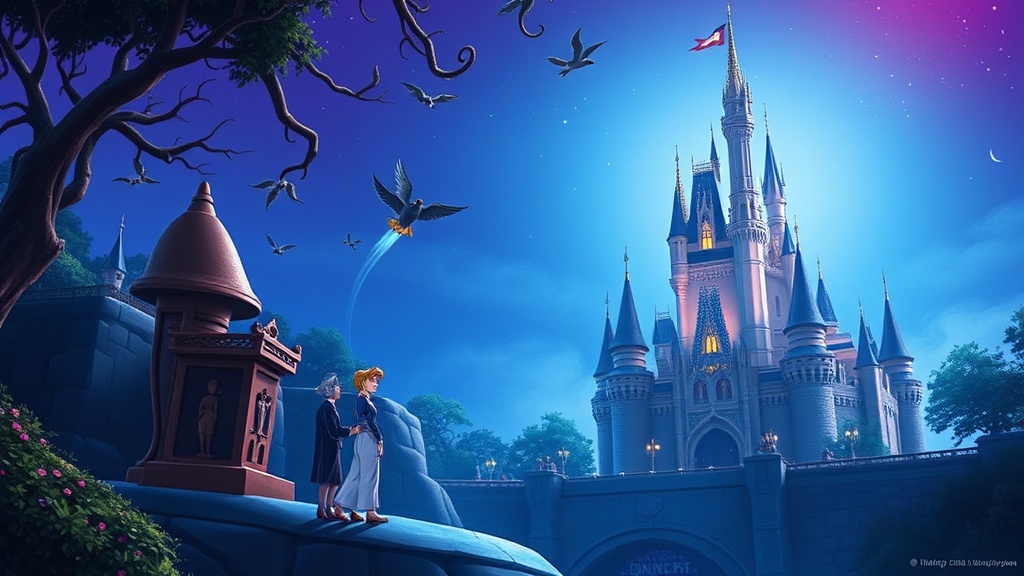
The Hidden Secrets Behind Disney's Most Iconic Animated Classics
What Hidden Animation Techniques Made Disney Characters Feel Alive?
The animators behind Snow White and the Seven Dwarfs (1937) didn't just draw princesses—they studied human anatomy for years. Walt Disney insisted that every character move with believable weight and emotion. The team brought in live actors to perform scenes, then traced their movements using rotoscoping. (This technique created that uncanny realism in Snow White's dance sequences.) The catch? Pure rotoscopy looked too stiff. So Disney's artists blended realistic motion with exaggerated cartoon physics—bendable limbs, squash-and-stretch facial expressions, and timing that made audiences feel something.
Frank Thomas and Ollie Johnston—two of Disney's legendary "Nine Old Men"—developed the Twelve Principles of Animation during this era. These weren't arbitrary rules. They came from watching what actually worked on screen. Squash and stretch gave characters flexibility. Anticipation prepared viewers for action. Follow-through and overlapping action made movement feel natural, not robotic. You'll notice these principles in every frame of Bambi (1942), particularly in the famous forest fire sequence where animals scatter with genuine panic—their bodies compressing and expanding with each leap.
The multiplane camera (introduced in The Old Mill, 1937) added another dimension. Multiple layers of painted glass created parallax scrolling—backgrounds moving slower than foregrounds. This wasn't just technical showmanship. It gave Disney films visual depth that flat competitors couldn't match. When the Academy Film Archive restored these classics, technicians discovered up to seven layers in some shots.
| Technique | First Used In | Visual Effect |
|---|---|---|
| Rotoscoping | Snow White (1937) | Realistic human movement |
| Multiplane Camera | The Old Mill (1937) | 3D depth in 2D animation |
| Xerography | 101 Dalmatians (1961) | Sketchy, hand-drawn line quality |
| CAPS Digital Ink | The Rescuers Down Under (1990) | Unlimited color palettes |
| Deep Canvas | Tarzan (1999) | 3D-painted backgrounds |
How Did Disney's "Nine Old Men" Shape Every Animated Film You Watch Today?
These nine animators didn't just work at Disney—they defined what character animation means. Marc Davis gave Cruella de Vil her theatrical swagger. Milt Kahl animated every Disney prince with the same attention usually reserved for heroines. Wolfgang Reitherman directed action sequences in The Jungle Book (1967) that still influence fight choreography in modern films.
Their influence extends far beyond the Disney lot. Pixar's John Lasseter started as a Disneyland Jungle Cruise skipper before studying their work. Brad Bird (The Incredibles) analyzed their scene planning for years. Even Studio Ghibli's Hayao Miyazaki cited Milt Kahl's animal animation as a major influence on Princess Mononoke.
Here's the thing about their process: they animated from the inside out. Before drawing a single frame, they understood what the character wanted. Shere Khan isn't just a tiger—he's aristocratic vanity personified. That personality drives every padded step, every dismissive glance. Modern animators at Pixar and DreamWorks still start with character motivation before touching a stylus.
The Vocal Performance Secret
Disney didn't just hire actors—he cast personalities. Sterling Holloway's trembling hesitation became Winnie the Pooh. Eleanor Audley's theatrical precision shaped Maleficent and Lady Tremaine. (Audley performed both roles using almost identical vocal inflections—proof that timing matters more than pitch.)
The animators recorded these voice sessions, then studied the footage. They drew mouth shapes matching specific phonemes—not just generic "open" and "closed" positions. This meticulous lip-sync technique created dialogue that felt conversational, not cartoonish.
Why Do Disney Songs Still Dominate Spotify Decades Later?
It's not nostalgia—it's architecture. The Sherman Brothers (Richard and Robert) treated every song as a storytelling device. "A Spoonful of Sugar" advances the plot while establishing Mary Poppins' philosophy. "Be Our Guest" serves as both welcome and character introduction for Lumière.
Howard Ashman changed everything in the late 1980s. Working with Alan Menken on The Little Mermaid (1989) and Beauty and the Beast (1991), Ashman applied Broadway musical structure to animation. Songs replaced dialogue scenes. "Part of Your World" isn't just a want song—it's the entire movie's emotional thesis condensed into three minutes. Broadway composers had written for film before, but Ashman integrated songs so completely that removing one would collapse the narrative.
The music theory behind these earworms is surprisingly specific. Disney songs typically follow AABA structure (verse-verse-bridge-verse) or build continuously like "Let It Go." They modulate upward for emotional peaks—usually by a semitone or whole tone when the singer hits their stride. Menken's scores use leitmotifs (recurring musical themes) so consistently that you could identify characters blindfolded. The Beast has low brass. Belle gets flowing strings. Gaston? Boisterous horns and percussion that match his inflated ego.
The villain Song Phenomenon
Villains get the best numbers. This isn't accidental—it's calculated release. "Poor Unfortunate Souls," "Be Prepared," "Mother Knows Best"—these songs let audiences enjoy evil safely. Ursula's jazz-influenced patter in The Little Mermaid references Cab Calloway and drag performance traditions. Scar's Nazi-inspired rally in The Lion King (1994) borrows directly from Triumph of the Will—a visual reference that sailed over children's heads but registered with adults.
Worth noting: these villain songs often use minor keys and chromatic passages that create unconscious tension. Your brain recognizes something's wrong before the lyrics confirm it. It's musical storytelling at its most manipulative—and effective.
What Production Systems Let Disney Release a Masterpiece Every Year?
Walt Disney built an assembly line that respected artistry. The studio used a director-unit system where lead animators supervised specific characters throughout production. Marc Davis handled all Cinderella scenes—regardless of which background artist or assistant drew the in-betweens. This created consistency. You never saw Cinderella's face morph between artists.
The Xerox process—pioneered for 101 Dalmatians—changed economics. Animators drew directly onto cels, eliminating the inking department. Lines got sketchier, more spontaneous. Costs dropped 40%. That said, something was lost. The lush, hand-inked perfection of Sleeping Beauty (1959) disappeared. Disney traded visual opulence for sustainability—and never looked back until the CAPS digital system arrived in 1990.
Modern Disney animation operates differently but follows the same philosophy: specialize deeply, review constantly, and never let technology overshadow performance. The CG films (Tangled, Frozen, Encanto) use proprietary software that mimics traditional drawing controls. Animators still think in terms of "appeal" and "staging"—terms coined by those Nine Old Men in the 1930s.
"The animation of today is the memory of tomorrow. You don't remember the software version—you remember whether the character made you care."
Disney's archive holds over 65 million pieces of animation art. Cels, backgrounds, concept sketches, maquettes—physical evidence of countless decisions made frame by frame. When Snow White premiered, critics called it "Disney's folly." Who spends millions on a feature-length cartoon? The answer, apparently, was someone who understood that entertainment isn't frivolous when it's crafted with care. That philosophy—treating family films as serious art—remains the real secret behind every classic bearing the Disney name.